Technical compliance guide
iGaming server compliance, jurisdiction by jurisdiction.
Server compliance is not a generic hosting badge. It is the controlled record connecting system functions, locations, data, communications, security, testing, approvals and releases to the rules of each licensed market.
Technical perimeter
Build a function-by-function compliance model.
Terms such as game server, gaming system, data warehouse and remote gambling equipment can have market-specific meanings. Start with what each component does, which data it handles and which approval covers it.
System and function inventory
Name every production component and function: game, wallet, account, payment, geolocation, reporting, logging, identity, integration and administrative access.
Location and regulator access
Establish where each function and dataset may reside, what must be locally accessible and how authorities or laboratories can inspect it.
Architecture and communications
Maintain current diagrams for trust boundaries, interfaces, environments, data flows, remote access, encryption and third-party connections.
Data logging and retention
Map required events, transaction records, timestamps, integrity, availability, retention periods, exports and reconciliation to the owning systems.
Geolocation and market controls
Preserve the approved geolocation design, test evidence, failure handling, blocked scenarios and monitoring appropriate to each market.
Identity, access and security
Connect authentication, privileged access, segregation, monitoring, vulnerability work, incident response and security evidence to specific duties.
Testing and approval scope
Track standards, local variations, laboratory submissions, regulator decisions, approved versions, conditions and unresolved approval boundaries.
Software change and release control
Classify changes against the approved system and determine notification, testing, approval, release-note and rollback requirements before deployment.
Evidence packet
Make the approved system and every material change reviewable.
A certificate is one part of the record. The team also needs to show the approved scope, local variation, current production state and decision behind each release.
Approved baseline
Current system description, component inventory, diagrams, versions, markets, approvals and conditions.
Requirement matrix
Local rules, adopted standards, licence conditions, regulator directions and the responsible control owner.
Test and security evidence
Laboratory reports, geolocation results, security assessments, control tests, exceptions and remediation.
Change assessment
Release scope, affected components and markets, approval classification, evidence, reviewers and rollback plan.
Production proof
Deployed version, release record, monitoring, incident and reconciliation evidence, with any post-release conditions.
Review history
Who decided what, when, against which material, with retained uncertainty and the next required review.
Release control
No deployment before the compliance classification.
A technical change can alter an approved component, data flow, control or market condition even when the customer-facing feature looks small. Put the classification before the release decision.
- 01
Describe the change
Components, functions, data, interfaces, markets and intended production date.
- 02
Compare the approved baseline
Identify what differs from the system, version and conditions already approved.
- 03
Check each market
Determine notification, testing, approval, release-note and evidence requirements.
- 04
Resolve dependencies
Confirm laboratory, regulator, supplier, security and operational inputs.
- 05
Approve and deploy
Retain reviewers, evidence, decision, deployed version, rollback and monitoring.
- 06
Reconcile production
Confirm the running state and close any post-release evidence or reporting conditions.
Official technical material
A baseline standard is not a universal market approval.
These official and standards-body materials illustrate the layers a technical file may need to reconcile. Confirm the current adopted version, local variations, regulator directions and precise approval scope before relying on any one document.
Gaming Laboratories International — GLI standards
GLI publishes standards including GLI-19 for interactive gaming systems and GLI-33 for event wagering systems, while making clear that jurisdictions set their own standards.
Michigan Gaming Control Board — technical bulletins
The published bulletin set separates server and equipment location, communications, data logging, geofencing and software approval or modification topics.
New Jersey Division of Gaming Enforcement — Chapter 69O
The Internet and Mobile Gaming rules define game servers, gaming systems, data warehouses and other system concepts, then prescribe market-specific controls.
Gambling Commission — remote technical standards
The RTS combines technical standards and security requirements for relevant Great Britain remote and software licence holders.
Atlas requirements
Compare technical requirements before planning a system change.
Review requirement text across jurisdictions, with the original sources in view. Use the comparison to identify questions for technical and compliance review—not to infer that one market’s approval applies in another.
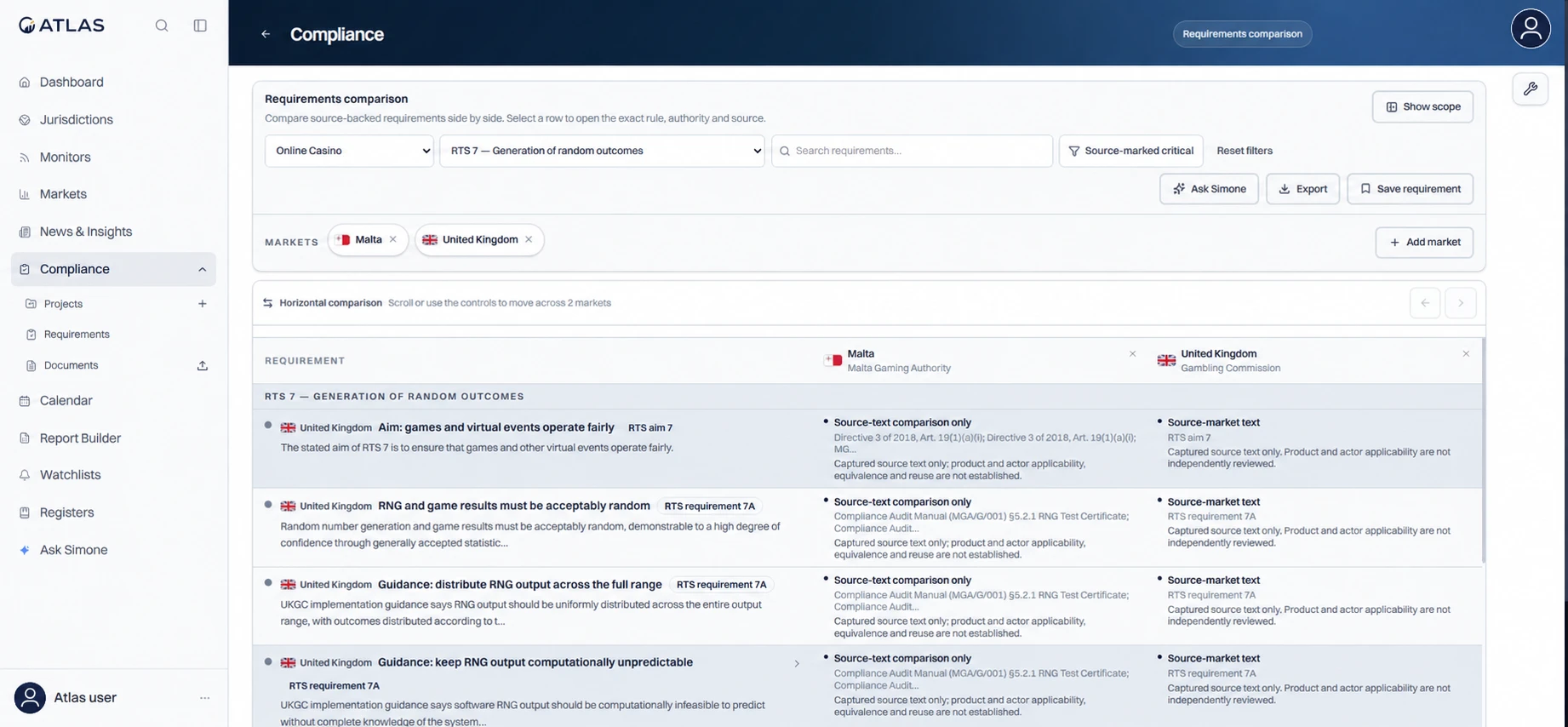
Compare technical requirements across jurisdictions, with source references in view.
Source-text comparison; applicability and equivalence require review. Account details anonymised.
Open full-size imageThis example compares Malta and UK text on random outcomes. It does not show hosting approval, system certification or release sign-off. Specialist testing and formal approval remain with the appropriate laboratory and authority.
Questions
iGaming server compliance FAQ
Short answers to the questions teams should settle before relying on a cross-market operating model.
What is iGaming server compliance?
iGaming server compliance is the market-specific work needed to show that the hardware, software, communications, hosting, data and operational controls behind an online gambling system meet applicable rules, licence conditions, technical standards, approvals and testing requirements.
Do iGaming servers have to be located in the licensed jurisdiction?
It depends on the market and the function performed. Some jurisdictions prescribe locations for particular equipment or stored data; others permit approved remote or cloud arrangements subject to access, security, reporting or recovery conditions. The answer must be established function by function, not inferred from the word server.
Which evidence should an iGaming technical compliance file contain?
A useful file can include the approved system description, architecture and data-flow diagrams, component inventory, requirement mapping, laboratory reports, regulator approvals, security evidence, geolocation and logging tests, release classification, change records, incident history and current ownership.
Does a GLI-19 certificate prove compliance in every market?
No. GLI-19 provides a widely used baseline for interactive gaming systems, but jurisdictions decide their own rules, adopted standards, variations, submission procedures and approval scope. Teams should preserve both the test evidence and the market-specific decision.
When does an iGaming software change need approval or testing?
That depends on the jurisdiction, approved system scope and nature of the change. Teams need a controlled classification process that checks the applicable rule, regulator direction, laboratory requirement and existing approval before deciding whether notification, testing or prior approval is required.
How does Atlas support iGaming server compliance?
Atlas lets teams compare technical requirements by market, read the original sources, and organise documents, review decisions and follow-up work in compliance projects. Registers support control tests and reviewer sign-off. Teams remain responsible for assessing their system and obtaining required testing and approvals. It does not perform laboratory certification, penetration testing, hosting or regulator approval.
Atlas
Put the market context next to the compliance work.
See how to compare requirements, review documents and organise assessment work for your priority markets.